
Physical coordinates
Components live in real micrometers, not abstract grid tiles — geometry is true from the first placement.
Layout, explicit routing, and simulation-aware loss in one editable model.
Lunima is an open-source intermediate PIC design software, actively in development.
The Lunima workspace — placing components, routing waveguides, and running a power-flow simulation.
A photonic die does not forgive bad geometry. Lunima routes waveguides as real S-bend and Manhattan paths between pins. One click of a button allows you to see the surfaces transmission and loss from the actual geometry.
Routed paths, not abstract nets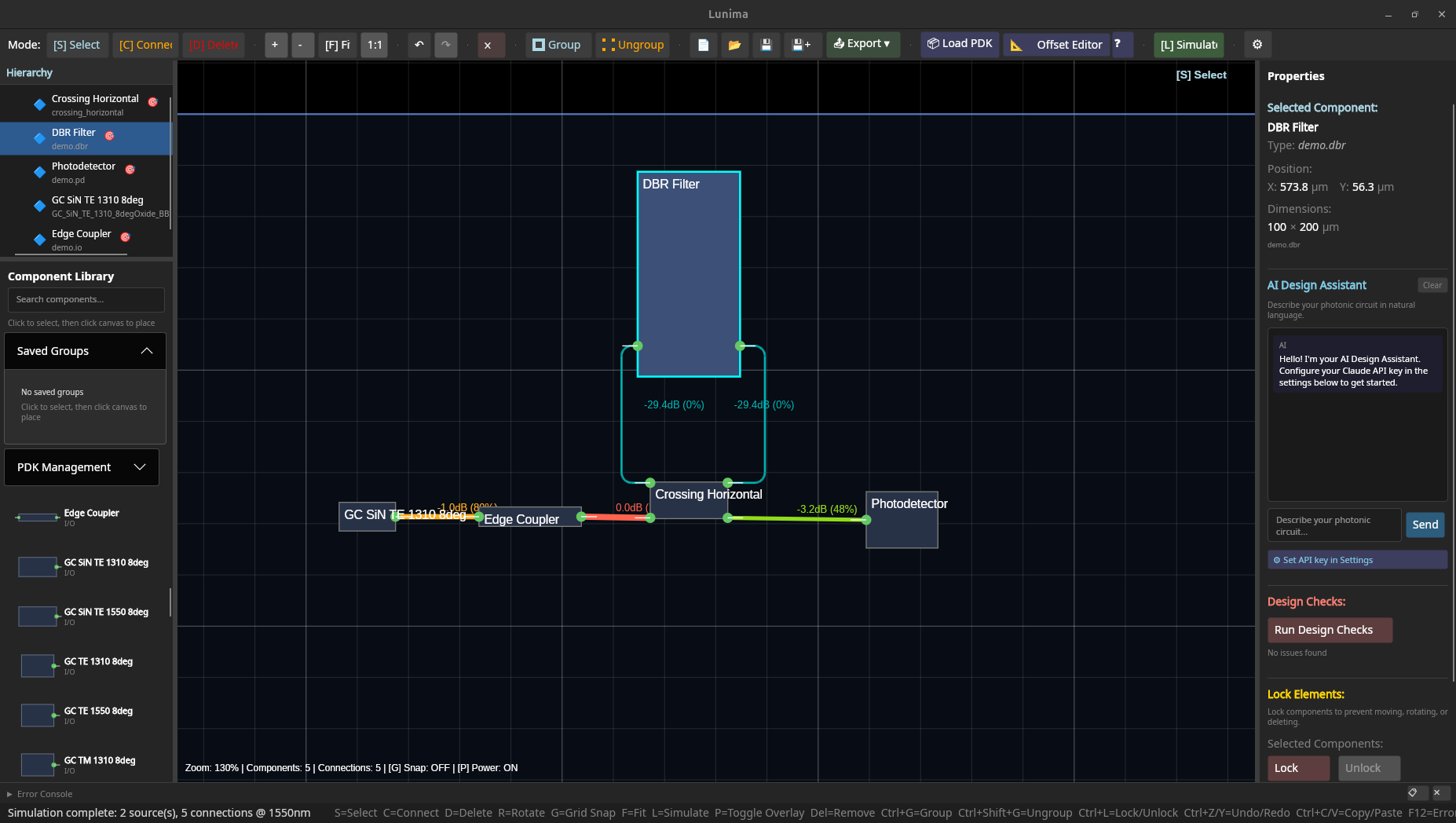
Work from PDK component libraries — splitters, couplers, phase shifters, grating couplers, detectors — each carrying physical pin positions and S-matrix data. Drop them onto the canvas and they behave like the parts they represent.
PDK-backed component library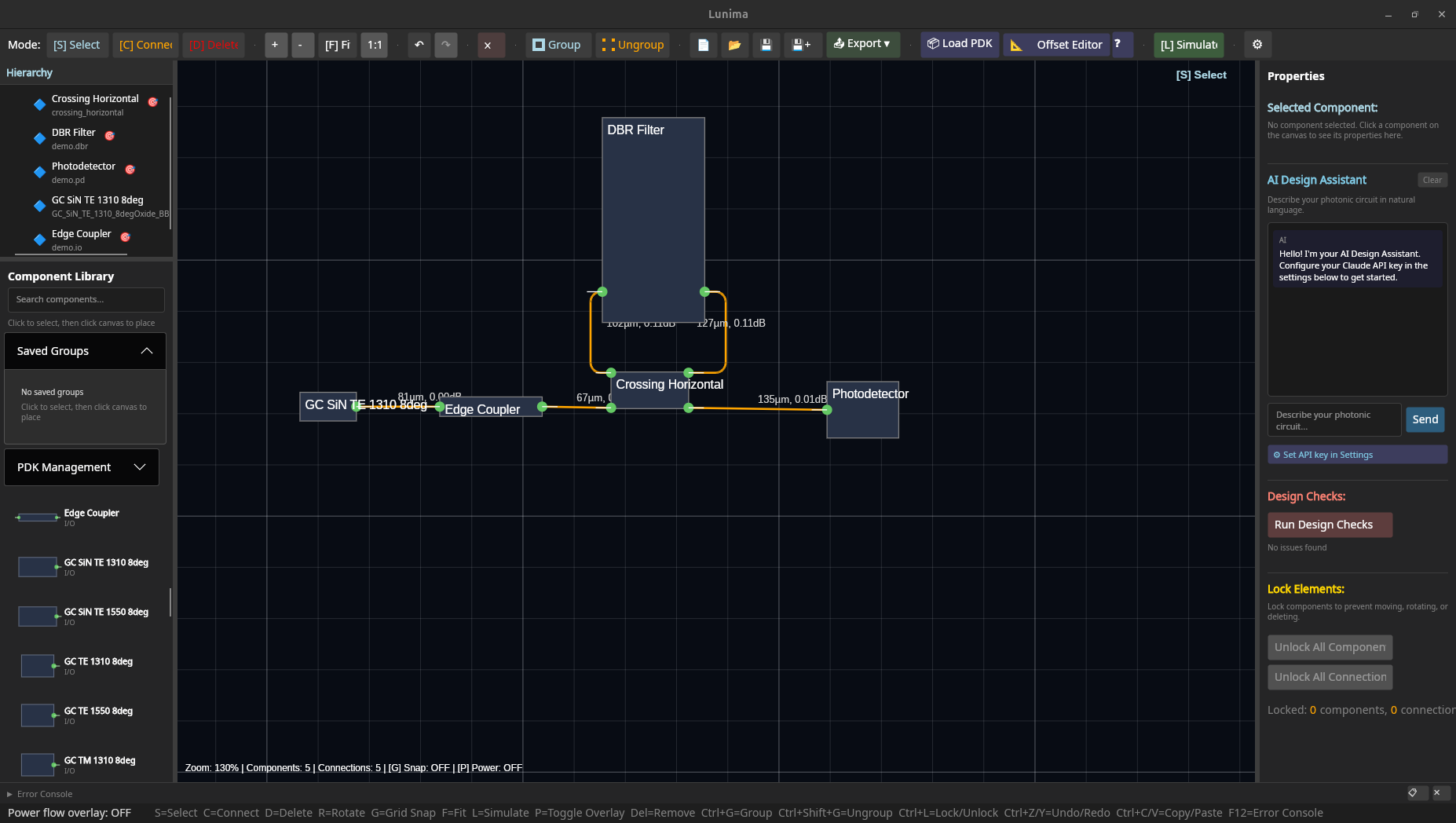
Export a single layout to the formats your team already runs — Nazca Python + GDS for fabrication, SAX/Simphony for circuit simulation, PhotonTorch for time-domain GPU runs, and Verilog-A/SPICE for co-simulation with electronics.
Nazca · GDS · SAX · PhotonTorch · Verilog-ALunima's assistant works over structured circuit state — components, pins, routes, hierarchy and physical constraints — so natural-language editing and exploration stay grounded in the real design, not a disconnected prompt.
Structured design contextComponents live in real micrometers, not abstract grid tiles — geometry is true from the first placement.
Waveguides are routed as S-bend and Manhattan paths between real pins, not drawn as abstract nets.
Build reusable subcircuits with external pins and frozen layouts, then compose larger systems.
Component libraries carry physical pins and S-matrix data, so parts behave like the devices they represent.
Transmission and loss derive from the actual path geometry, keeping design intent tied to physics.
Built on the open Lunima engine, with Nazca export to hand off to the fab flow you already run.
Lampsi Labs is focused on making photonic chip design open, approachable, and grounded in the physics of real devices.
Lunima provides the open-source core — physical layout, PDK-aware components, explicit waveguide routing, simulation-aware loss calculation, hierarchy, and exports to your existing workflow. From there, Lampsi Labs is building toward physics-informed, routing-aware photonic layout automation.
A team of ex-FAANG engineers and photonics researchers, advised by professors at the top of the field.
Pick your platform. The app installs, runs, and updates locally.